- Have any Questions?
- +91 8130779884
- daulatenterprises.mm@gmail.com

Best Way to Wash Solar Panels Using Solar Panel Cleaner (SPERESIK-4G)
December 10, 2025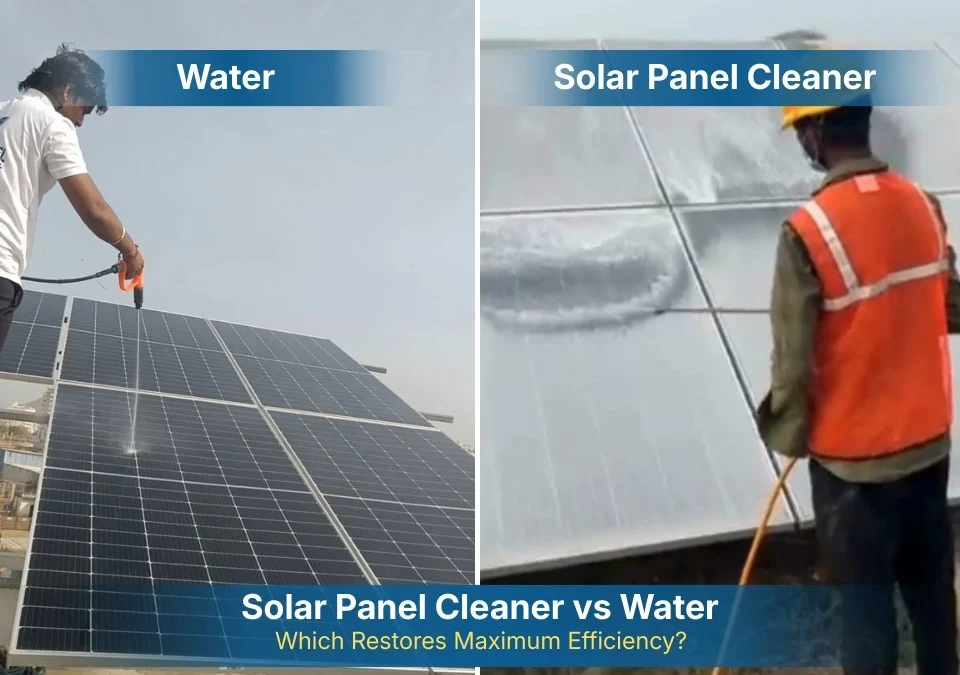
Solar Panel Cleaner vs Water
Thinking about why your solar panel has lost its efficiency? Then you need to understand that it doesn’t happen suddenly. Dust, pollution, bird droppings, and hard water can cut efficiency by 5-20% without giving any obvious signs. And here, many owners think rinsing with water is enough. But is it? To answer that, we will break down water vs cleaner for solar panels in this guide. We will learn about how buildup affects efficiency and when a solar panel cleaner is needed to maintain consistent energy output.
What is a Solar Panel Cleaner and How It Works?
Solar panel cleaner is a residue-free formula that prevents thin films from forming. This thin film can block sunlight and reduce panel efficiency by measurable amounts over time. This special solution is designed to remove dust, pollen, and mineral deposits that ordinary soap cannot.
Let’s learn how this formula works.
The cleaner starts by breaking the bond between the dirt and the glass. It helps in lifting the dirt from glass without scrubbing. This way, micro-scratches or damage to the protective coating can be avoided. It also keeps the surface fully transparent while letting the sunlight pass through it. Eventually, in areas with hard water and pollution, energy output can be stored.
How to use it?
Using the solar panel cleaning solution is very simple. Just start by spraying or gently wiping the panel, then lift the bonded residue and let it dry naturally. This method protects the glass, prevents streaks, and maintains long-term performance. This makes it a safe and effective part of regular solar panel cleaning.
Water vs Solar Panel Cleaner: Which Works Best?
The right cleaning method actually depends on the type of buildup and environmental conditions. Water can remove thin-layer dirt, but heavy residue or hard water stains for sure need a solar panel cleaner for efficient cleaning of panels. This is why it’s important to learn the differences so that you maintain the output and reduce unnecessary time.
| Condition / Buildup | Water Only | Solar Panel Cleaner |
|---|---|---|
| Light dust | Removes surface dust but may leave micro-particles behind; frequent rinsing needed | Lifts dust fully in one pass, prevents residue buildup, restores light transmission efficiently |
| Hard water/mineral deposits | Leaves white spots and thin mineral films, which reduce sunlight penetration | Dissolves and lifts calcium and other mineral deposits while keeping the surface streak-free and clear |
| Pollution / sticky grime | Often ineffective as particles bond to glass, resulting in partial output loss | Breaks down bonded grime safely, which helps in restoring full energy output without scrubbing |
| Bird droppings/pollen | May smear or require repeated cleaning | Softly removes organic residue, preventing stains and maintaining transparency |
| Panel safety | Risk of micro-scratches if too much pressure is applied | Gentle on coatings with minimised risk of surface damage |
| Maintenance frequency | High – repeated cleaning needed to maintain efficiency | Moderate – results last longer with fewer cleanings |
| Energy output recovery | Partial; panels rarely return to peak | Maximum as the light absorption is restored effectively |
After looking at the comparison, you might have understood how effective solar panel cleaners are compared to water. Let’s move on to see what research says about this difference.
Why Solar Panels Fail: What Field Studies Show?
Solar panels don’t fail suddenly. It slowly starts by piling up dust, dirt, and debris. This way, sunlight gets blocked even before it comes into notice. Initially, light dust may cause a small dip, but over time, this can negatively affect the efficiency of capturing energy.
Field observations show measurable differences depending on buildup:
- Light dust: 2–5% output drop
- Moderate buildup: 10–15% drop
- Heavy deposits: 15–20% or more
These ranges reflect real-world operational conditions rather than hypothetical lab assessments. However, it all depends on location, exposure, and environmental factors such as pollution, industrial zones, or seasonal pollen. Bird droppings can further increase the effect.
Mineral films and hard water leave behind a sticky layer that rain can’t wash off. Over time, this layer blocks light and makes panels harder to clean. But when you choose regular maintenance with the right solar panel cleaner, it can effectively prevent long-term buildup. But not all efficient solar panel cleaning methods restore clarity equally. Therefore, let’s learn what are the risks that need avoiding.
Performance Triggers and Surface Damage Risks
Monitoring panel performance can reveal early cleaning triggers. The unexplained 5-10% drop in output can be seen as a signal of early residue buildup. Readings from an inverter may fluctuate because particles block the light. Even the newly installed solar panels can get dust or a thin layer of dirt while getting connected. This can lead to an ineffective system if they are not cleaned up properly. Below are a few examples of long-term damage caused by improper cleaning.
Hard water stains: They leave permanent marks if not treated on time.
Micro-scratches caused by sharp tools: Reduce light transmission and accelerate degradation.
Seal or coating stress: Excessive pressure or harsh chemicals can degrade protective layers.
DIY errors: Improper brush or cleaning agent use can exacerbate residue instead of removing it.
After learning about the risks, the question arises: how to avoid it? The answer is simple. Using solar panel cleaners such as SPERESIK-4G can prevent these issues. With the proper cleaning agent, you can maintain a stable level of energy production.
Cost vs Output Recovery – When Cleaning Becomes a Financial Decision
A minor loss of efficiency can have a profound impact on output and cost. If a 5 KW residential system, which has already lost 10% efficiency, generates energy, it will only translate into a measurable financial loss. The following quick guide will help you determine when proper cleaning is necessary.
- Light dust, soft water stains: Water may be beneficial, as it does not have any significant effect.
- Hard water, pollution, sticky deposits: Using the right solar panel cleaner is important, as it will restore output more effectively.
- Commercial systems: Even a 5–10% loss affects revenue, making efficient cleaning methods a practical investment.
To maintain a balance in cost and energy recovery, it is necessary to adopt the right and affordable methods for cleaning solar panels. Good cleaning means cleaning is not needed repeatedly, which saves time and money. Also, the panel’s strength is maintained, and it works at its full efficiency. Whether the panels are installed at home or commercial, this is essential for both types of setups.
Conclusion
In the end, it is safe to say that while water can help in cleaning loose dust, further than that, you need a proper solar panel cleaner. To remove stubborn water spots, pollution layers, and grime that have adhered to the solar panel, it would be a wise decision to opt for a cleaner such as SPERESIK-4G. This will help maintain the performance of the solar panel, and it may also prevent permanent damage to the solar panel surface. This will ultimately lead to fewer services being required.